
| Department/Committee/Club | Department of History |
| Title of the Activity | Heritage Walk through Fontainhas, Panjim |
| Date of the Activity | 10th October 2025 |
| Nature of the Activity | Offline |
| Venue | Fontainhas, Panjim |
| Academic Year | 2025–2026 |
Objective(s) of the Activity:
- To provide experiential learning about Goa’s colonial and architectural heritage through on-site exploration.
- To enhance students’ understanding of the historical and cultural evolution of Panjim’s Latin Quarter.
Activity Overview:
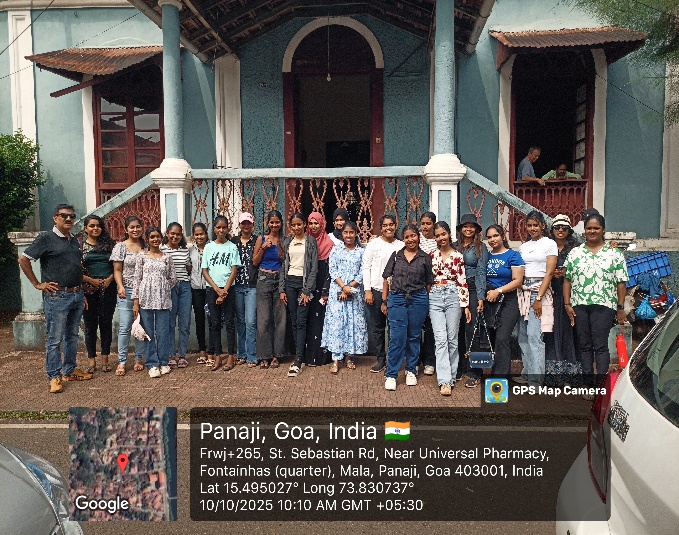
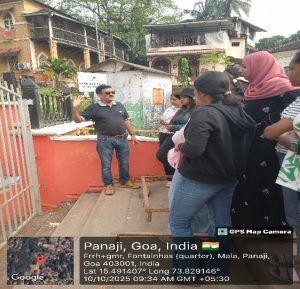 The Department of History organised a Heritage Walk through Fontainhas, Panjim for the TYBA History (VET) students on 10th October 2025. A total of 20 students participated in the walk, accompanied by faculty members Ms. Anette Gomes and Ms. Abigail Barreto. The resource person for the heritage walk was Mr. Jesus Ribeiro, who guided the students through the various historical and architectural landmarks of the area.
The walk commenced at the Maruti Rai Temple, where the students also viewed the adjoining water tunnels. Mr. Ribeiro explained the origin of the name Fontainhas, derived from the word “fountain,” as the area was once supplied by streams from the nearby hills. The students next visited Mala, where they learned about the “steps of the barber” and how the locality derived its name from the community of barbers (mhalo in Konkani).
Further, the students explored the vibrant Portuguese-era houses known for their distinct colours and architecture, which lend the area its identity as Goa’s Latin Quarter. A special stop was made at the residence of Antone Sequeira de Nazerath, a Goan who had returned from Mozambique and contributed to the development of this part of Panjim.
The group then visited Fundação Oriente, which houses several significant paintings, followed by the site of the Pinto Conspiracy of 1787 and the public wells that once served the community. The walk concluded at the St. Sebastian Chapel, noted for its unique statue of the Crucified Christ with open eyes, and finally at the Bishop’s Palace in Altinho, where the students observed its architectural style and portraits of various Archbishops of Goa over time.
The heritage walk provided students with valuable insights into Goa’s colonial past, architectural heritage, and cultural identity. It proved to be an enriching and memorable learning experience.
Outcomes of the Activity:
- Students gained first-hand exposure to Goa’s urban heritage and Portuguese-era architecture.
- The activity strengthened their appreciation of the importance of heritage preservation and cultural documentation.
Beneficiaries:
| No. of Students | 20 |
| No. of Staff | 2 |
| Total Participants | 22 |