
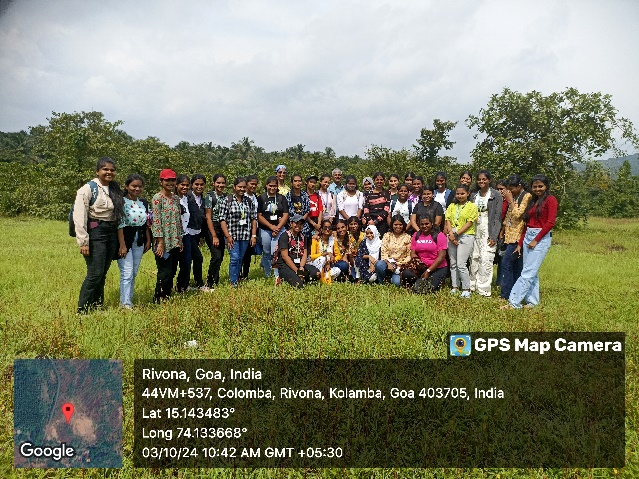
As part of the academic curriculum requirement for the semester III Botany (Minor) course in Plant-Animal Interactions, a field study trip was organized for S.Y. B.Sc. Botany (Minor) students to Rivona Sada on 3rd October, 2024. Faculty members Dr. Divakar Mesta and Dr. Kim Rodrigues accompanied the students as they walked along the lateritic plateau and adjoining forest at Rivona Sada to observe plant-animal interactions, different pollinators visiting the flowers and types of fruits and their dispersers.
During the walk, students observed various species of herbs, shrubs and trees in bloom, providing a rich resource of nectar for pollinators. A brief explanation was given of field characters along with botanical name and family of the plant species observed. Students observed different types of pollinators including bees and butterflies. Some of the key interactions that were documented include, a mating pair of common grass yellow butterflies sitting on a grass, spider nests on leaves of Odina wodier, insect galls on a member of Vitaceae family, insectivorous plant Utricularia that traps its prey using a suction mechanism, insectivorous plant Drosera indica that traps its prey using its sticky glands, Acacia catechu with thorns as defense mechanism, Lepidagathis sp. with sharp leaf tips as defense mechanism, Randia dumetorum with strong thorns as defense mechanism, Sepium insigne with poisonous latex as defense mechanism, Crotalaria sp. which serves as a host plant for butterflies, presence of butterfly eggs on tender leaves of a plant, Helicteres isora with tubular bright orange flowers to attract bird pollinators, and Mussaenda frondosa with a brightly coloured sepal and Murdannia spp. with purple coloured flowers to attract insect pollinators. Memecylon umbellatum, an endemic tree of the Western Ghats was also observed.
Students gained valuable insights on the dynamic interactions between plants and animals in this unique ecosystem. The diversity of pollinators contributed significantly to the reproductive success of local flora. Students were later guided to prepare a report with reference to the plant-animal interactions observed during the field study trip.