
| Department/ Committee/ Club | Botany |
| Title of the Activity | Field Study Trip to the Plant Nursery at Salaulim Botanical Garden, Sanguem |
| Date of the Activity | 16th September 2025 |
| Nature of the Activity | Offline |
| Venue | Botanical Garden at Salaulim Dam , Sanguem |
| Academic Year | 2025-2026 |
Objective(s) of the Activity:
- To impart knowledge of the basic structures used in plant propagation.
- To familiarise students with various methods employed to propagate plants.
Activity Overview:
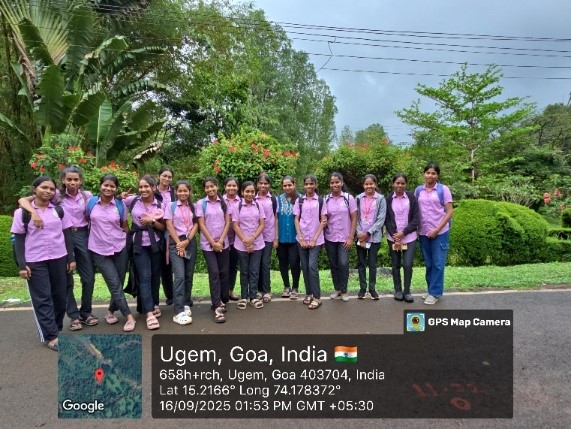
As part of the curriculum of the MC Botany BOT-231 Plant Propagation Methods course, a field study trip was organized on 16th September 2025 to the plant nursery at the Botanical Garden at Salaulim Dam, Sanguem. The purpose of this visit was to provide students with practical exposure to various plant species and their propagation techniques. A total of 25 students from S.Y. B.A. and S.Y. B.Com. attended the trip. The students were accompanied by Dr. Janet F. Vaz e Mascarenhas, faculty member of the Department of Botany.
The dam, built on the Salaulim River, is Goa’s largest water reservoir and supplies water for irrigation, domestic use, and power generation. The surroundings of the dam has a botanical garden which includes a plant nursery, where the students observed a wide variety of ornamental plants like Bougainvillea, Hibiscus, Ixora, Marigold, Chrysanthemum, Palms, etc. The nursery also makes use of protected propagation structures such as polyhouse and shade house for raising ornamental flowers (e.g., Marigold, Chrysanthemum, etc.) and grafted saplings (e.g., Rose, Mango, etc.). The students also gained information on different vegetative propagation techniques such as cutting and grafting.
The visit to the plant nursery at the Botanical Garden at Salaulim Dam was an enriching experience. The students gained valuable knowledge of plant diversity and their propagation methods. The field trip not only supplemented classroom learning but also enriched the students’ knowledge through direct observation and interaction with the plants in their natural surroundings.
Outcomes of the Activity:
- Students gained knowledge of the basic structures used in plant propagation.
- Students learnt about the various methods employed to propagate plants.
Beneficiaries:
| No. of Students | 25 |
| No. of Staff | 01 |
| Total No. of Participants | 26 |